


Jonathan Anderson’s Dior: Odysseus's Journey Home
- Mar 17
- 5 min read
BY IOAN LEWIS
MARCH 17, 2026
Jonathan Anderson is perhaps the hottest name in fashion at this very moment, especially following his unprecedented, third successive claim of the Designer of the Year award, at the 2025 British Fashion Council’s Fashion Awards. Although this is Anderson’s third Designer of the Year, it is his first since taking over the helm at Dior in March 2025, as their first creative director solely in charge of menswear, womenswear and couture. Despite the idea that Anderson currently stands at the precipice of fashion canonisation, a house like Dior holds lofty expectations, storing memories of his predecessors like a private museum. Jonathan already has a few Dior showings under his belt, and considering the amount of previous work upon which comparisons can be drawn, his decisions have been nothing short of… interesting.

Courtesy of Loewe
Understanding Anderson’s journey is fundamental to understanding his inspiration at Dior and the reaction to it. His story began in Northern Ireland, whereby Anderson eventually flew the coup to etch his name in Madrid marble, and now lending his talents to a French deity. His explosive European tour has him on the trajectory of a Greek epic, and like all great stories, it’s best to start at the beginning.
Fashion has always been stitched into Anderson’s genes, as his grandfather had been a textile designer before the family caught the rugby bug. This bug might have been the cause of Anderson’s initial disinterest in his grandfather’s heritage, as at 18 he moved to America to study acting at the prestigious Juilliard School. This endeavour didn’t last long, as a familiar, familial call echoed, and as if guided by a Dickensian ghost, Jonathan became enamoured by costume design. This paring became an extremely fruitful one for both Anderson and the greater fashion-loving community. Following this newfound spark, Jonathan briefly returned to the warm, homely stew of Dublin to work at retailer Brown Thomas before eventually setting his sights on the European capital of hopes and dreams, enrolling and graduating from the London College of Fashion in 2005. Following graduation, he became a visual merchandiser for Prada before announcing himself on the world stage, figuratively and literally, launching his eponymous label, JW Anderson, in 2008.

Courtesy of J. W. Anderson
JW Anderson became a massive success during the 2010s, capitalising on the decade-defining commercial trends of minimalism and collaboration. Despite his background, upbringing and his catwalk weathered Irish rugby jersey, JW Anderson seemed like a woolly blend of home county and Scandinavian influence in both aesthetic and quality. Jonathan has neither been a stranger to deviation, with the brand booming in popularity through colourful collaborations with the likes of A$AP Rocky’s conglomerate AWGE, Moncler and a longstanding relationship with UNIQLO. Every now and then, Anderson’s future would peak through his chrysalis, as more complex and extravagant creations would occasionally swan through the curtains.

Courtesy of Loewe
After five years of continuous and expansive success, LVMH took a minority stake in JW Anderson and named Anderson as the new creative director, and hopeful saviour, of struggling Spanish luxury house Loewe. Not considered as a gargantuan move at the time, other designers will remember this as the ‘Medusa Moment’ when they became decoration, set in stone, embellishing the walkway towards the bust of a great conqueror. It was here at Loewe that Anderson truly landed with such an impact that his footprint has since fossilized. Yet Loewe was jammed in neutral; the once celebrated European powerhouse was at risk of being lost to the annals of history. Loewe needed a jumpstart, a spark to restart a withered heart. Jonathan Anderson, conversely, decided to douse it in petrol, sulphur and adrenaline and dropped a match.
Gone were the neutral pastels of his past; Jonathan Anderson was experiencing a creative metamorphosis. Bright colours kicked down the door, merely to compere the handiwork to follow. Experiencing this era of Loewe was like a lucky dip at the Met Gala; you never knew what you were going to get, but you were assured that it would be good. One month would bring focused flows; dresses and skirts idyllically draped as if caught in a perfectly perpetual spring gust. The next month would bring a masterclass lecture in ingenuity and optical genius that would be the envy of the H.L Smoke and T.L Mirrors brothers. The month after, outfits would be adorned with museum-worthy, yet functional, sculptures. Anderson’s 11 years at Loewe, especially the latter years, were undoubtedly one of the greatest outpourings of artistic effort and passion that the industry had seen for at least a decade. Anderson was a year away from a Rondeau Prime; such was his poetic romanticism for fashion at Loewe… and then came Dior.
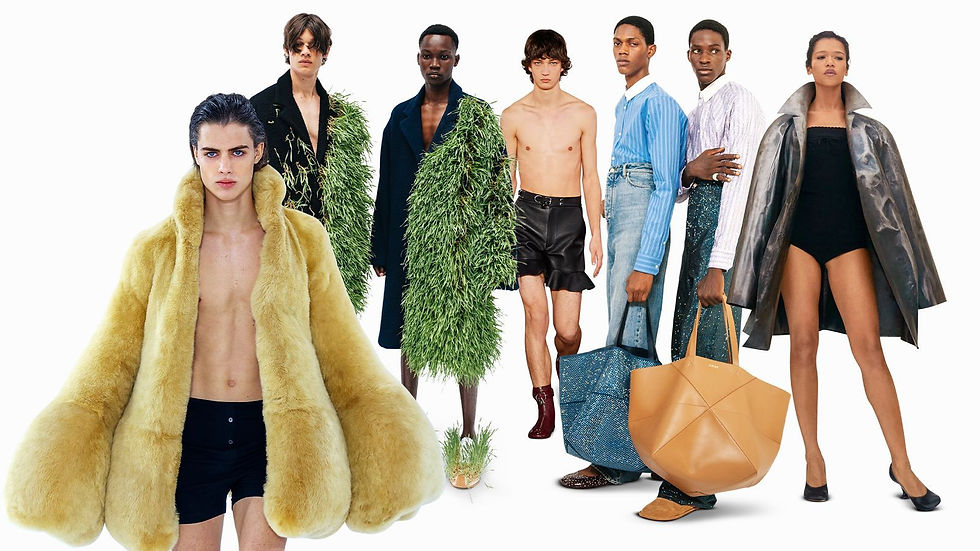
Courtesy of Loewe
Whereas it seemed that his awakening came at Loewe, it might simply have been an experimental period, as Dior feels much more a return to J.W. Anderson than a slingshot from Loewe. Gone is the brave and the bold, gone is the realisation of creative grandeur; welcome back muted colours and minimalism. Perhaps this is a journey back home, a reappearance at university following a lengthy and exciting gap year. Perhaps this is an opportunity for an experienced Jonathan Anderson to stamp his refined image onto one of the biggest names in the industry. Perhaps a certain writer is simply a bumbling dilettante who prefers his clothes to feel more like receiving a punch in a bar brawl than a Wordsworth summer. Given the plaudits that his initial collections have attracted, this is probably correct. There’s nothing inherently wrong or bad with his first showings, and some aspects of his time in Spain have certainly been carried over, especially when discussing silhouettes. The pieces are aesthetically pleasing, obviously built of fabrics once demanded by Pharos and with expertly sewn and trimmed silhouettes that bring much-needed life and movement to the collections. The colours are nice. Warm, nice and partnered well on the catwalk.
Anderson’s third collection has shown signs of life; his FW 26 presentation certainly had a French connection. Tailcoats and long johns dominated conversations as the show took on the identity of pseudo-revolutionary couture. This was blended with a youthful punky focus as glistening low-cut shirts and tassel-adorned polo shirts provided a spark where necessary. The collection was akin to making cocktails on a budget, mixing red wine and own-brand vodka, only to be pleasantly surprised at the final result. Whereas his recently released haute couture line also left room for pause to consider whether this criticism was too trigger-happy. Nevertheless, there remains a distinct and slightly unnerving calmness, a quietness where once there was an unending guitar solo.

Courtesy of Dior
Kim Jones opened the door for creative input and export at Dior, so it is surprising to see Anderson return down the ladder instead of spring boarding to perfect tens. It’s strange to see fanfare directed at a grey logo jumper when not too long ago it was directed at his boldness and innovation. History shows us that excessive opulence is almost always the cause of the fall. Anderson might be aware of this too, and in an attempt to avoid his Icarus moment, returned to the safe shores of high-quality minimalism sprinkled with shavings of excitement. This is not generally contentious, especially when considering Dior’s lineage; people love minimalism, and they seemingly love his start at Dior. Nevertheless, to fall is to have soared. Jonathan Anderson is only just beginning with Dior; his reputation more than precedes him, and there should be no doubt that he will go on to achieve more wondrous things as he tightens his grip on the reins. That same reputation also lends a hand to the hope that he might just get an itch in his feathers again, to see us all from up there once more.


Comments